Puffer combines liquid restaking with Ethereum rollup infrastructure
Puffer lets users stake ETH for pufETH and builds rollup infrastructure that links faster transaction preconfirmations with Ethereum settlement. Its liquid restaking product represents staked ETH in a token, with rewards tied to validator ticket payments and supported restaking services. UniFi provides the Layer 2 execution environment, and Preconf supplies early commitments about transaction execution. Institutional staking adds configurable asset controls. These functions share an Ethereum foundation, yet each relies on different operators, contracts, and completion conditions.
Bottom line: pufETH's ETH value can grow when rewards exceed penalties, while UniFi preconfirmations arrive before final settlement on Ethereum.
Stake ETH while keeping a tokenized position
The staking product turns an ETH deposit into pufETH, a token representing the depositor's stake. The underlying capital helps fund Ethereum validators, while the token remains in the holder's wallet. That separation lets someone hold a staking position without operating validator infrastructure. The protocol's rewards and penalties affect pufETH's ETH value, so a changing wallet token count isn't necessary for the position to earn.
ETH is the starting asset for the native staking route. The staking interface also supports WETH, stETH, and wstETH, with different token handling and authorization requirements. WETH wraps ETH; stETH represents liquid-staked ETH; wstETH wraps stETH. These assets don't share every approval rule or conversion calculation. The chosen asset determines which authorization the deposit requires. Those distinctions concern entry into the staking product. Moving assets to a rollup involves a separate bridge and network context.
Native restaking extends Ethereum validation
Puffer's native liquid restaking protocol integrates with EigenLayer. Ethereum validators use staked ETH to participate in proof of stake. Native restaking lets validator ETH support additional services through EigenLayer, with duties and penalty conditions that those services set. Additional rewards depend on actual service participation and the rules that govern it. The ability to restake ETH doesn't establish a fixed additional yield for every position.
Protocol modules organize validators and their restaking exposure. Node operators handle Ethereum validation, while designated restaking operators perform additional service work for participating modules. An actively validated service, or AVS, is one of those externally secured services. This division lets validator operations and AVS duties use different operational arrangements. Restaking rewards and losses reflect the selected services and the operators that perform their work. More reward sources also bring more conditions that can affect the assets backing the staking token.
Rewards that exceed penalties can increase the ETH backing each pufETH token, while net losses can reduce it.
Validator tickets pay for validator operating rights
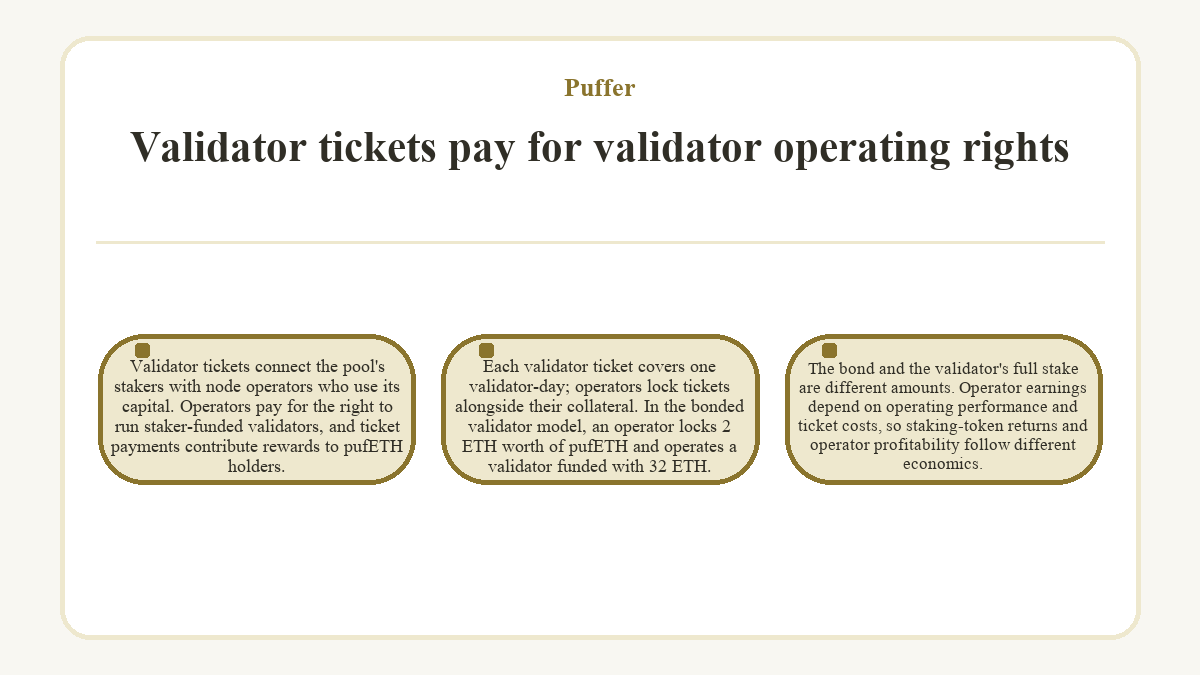
Validator tickets connect the pool's stakers with node operators who use its capital. Operators pay for the right to run staker-funded validators, and ticket payments contribute rewards to pufETH holders. Each validator ticket covers one validator-day; operators lock tickets alongside their collateral. In the bonded validator model, an operator locks 2 ETH worth of pufETH and operates a validator funded with 32 ETH. The bond and the validator's full stake are different amounts. Operator earnings depend on operating performance and ticket costs, so staking-token returns and operator profitability follow different economics.
UniFi brings transaction execution closer to Ethereum
UniFi is an Ethereum Layer 2 based rollup, an execution environment that coordinates with Ethereum's base layer. Based sequencing uses Ethereum validators to determine transaction order. The rollup handles application execution, and Ethereum remains the settlement layer. UniFi's synchronous composability design uses a Signal Service on the OP Stack. It supports atomic operations across UniFi and Ethereum within the same Ethereum slot.
Developer access includes a UniFi testnet and a native bridge for testnet assets. That environment supports development and testing of rollup interactions. Its transfers concern test assets and test-network behavior. Payment applications, trading systems, and automated transaction software are intended uses for the execution model. Their availability depends on the relevant deployment and integrations.
Preconf links gateway commitments with Ethereum settlement
Gateway ordering
A rollup that integrates Preconf can use a registered gateway to receive transactions and apply ordering policies. The gateway provides an execution preconfirmation ahead of Ethereum settlement, committing to the transaction's execution outcome. Its practical meaning depends on the commitment and the protocol rules that enforce it.
The September 22, 2026, Google Cloud partnership included gateway registration and designated UniFi as its first planned rollup deployment. Rollups can select gateway infrastructure through the registry, with combined configurations enabling parallel processing or fallback arrangements when an integration supports them.
Early execution and final settlement
An execution preconfirmation precedes final settlement on Ethereum. Applications can use the gateway's execution commitment for early transaction feedback, but it doesn't establish Ethereum finality.
Protection within each rollout phase
Preconf's economic security model uses restaked ETH, and its penalty rules determine which failures that backing can protect against. The Phase 1 design uses reward forfeiture for missed block proposals. The rollout plan places full slashing and user refunds in a later phase.
When a deployment only forfeits rewards, a failed commitment doesn't automatically redistribute slashed stake to affected users. Additional penalty and refund mechanisms change that protection when they become operational. The commitment's enforceable terms determine the response to a failure. Fast timing alone doesn't establish a compensation entitlement.
Read a staking balance and a preconfirmation differently
In a hypothetical comparison, an ETH deposit has minted pufETH, and a separate UniFi transaction has received a gateway preconfirmation. What has each part of the system established?
A tokenized stake
The pufETH balance represents an ETH staking position within the liquid restaking product. The holder can interpret it as a claim on the assets backing that token. It doesn't establish that the underlying ETH has reached the wallet through a withdrawal. That separate outcome depends on the exit route and liquidity.
An early execution commitment
The preconfirmation concerns the UniFi transaction's execution outcome before Ethereum settlement. An application can use that response for early feedback about the transaction. It can't treat the response as evidence that Ethereum has finalized it. Those interpretations apply while the token represents the stake and the transaction remains preconfirmed.
Withdrawals follow the product that holds the assets
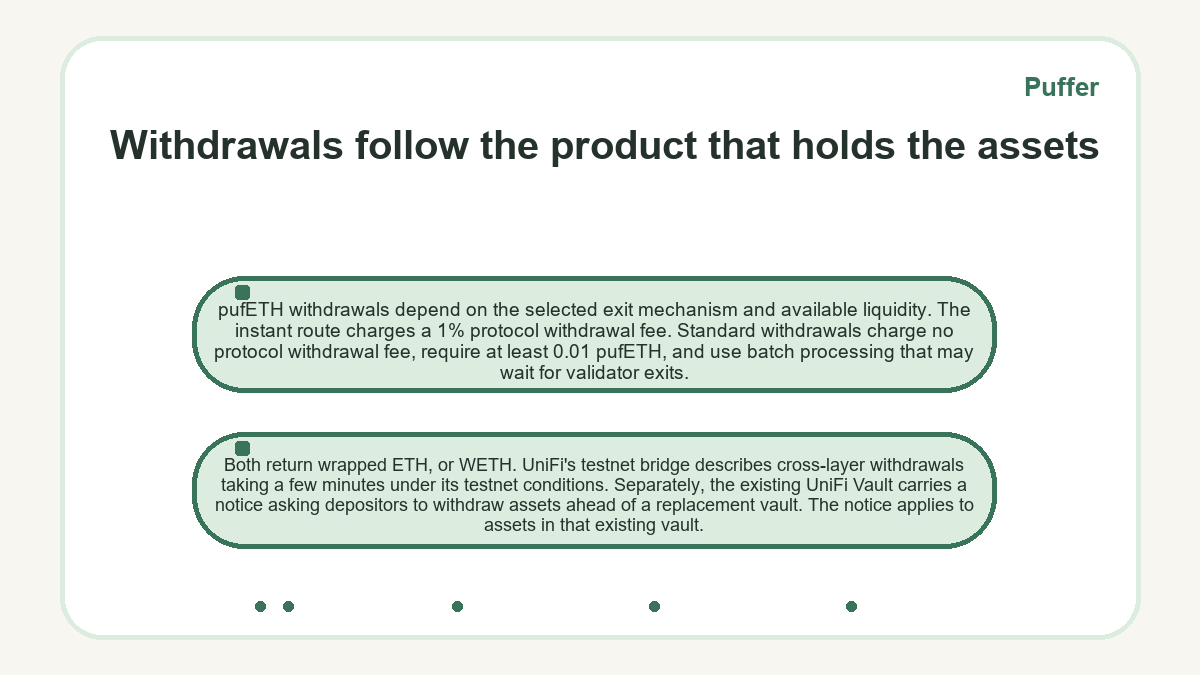
pufETH withdrawals depend on the selected exit mechanism and available liquidity. The instant route charges a 1% protocol withdrawal fee. Standard withdrawals charge no protocol withdrawal fee, require at least 0.01 pufETH, and use batch processing that may wait for validator exits. Both return wrapped ETH, or WETH. UniFi's testnet bridge describes cross-layer withdrawals taking a few minutes under its testnet conditions. Separately, the existing UniFi Vault carries a notice asking depositors to withdraw assets ahead of a replacement vault. The notice applies to assets in that existing vault.
Institutional staking and custody address different controls
Configurable staking vaults
Puffer Institutional provides a configurable staking and restaking platform with dedicated vault infrastructure, and its AccessManager contract controls vault permissions. Authorized roles handle validator deployment, reward management, and upgrades. Institutions can assign different responsibilities to different accounts. The chosen permissions determine who can move assets or change the configuration. Dedicated contracts also organize staking operations and reward distribution around the institution's selected arrangements.
A dedicated vault changes the control arrangement. Ethereum validation and restaking services still introduce their respective operating duties and penalty exposure.
Custody and payment infrastructure
The partnership with Anchorage Digital announced on September 29, 2026, designated the company as UniFi's day-one institutional custodian. The collaboration also covers stablecoin infrastructure, native settlement, and payments initiated by software agents. Custody concerns how institutions hold and access assets. UniFi supplies the execution and settlement environment, while the custody provider supplies institutional asset access. The designated custody role ties to UniFi's launch. Each planned payment capability also requires its own integration, so these arrangements don't make custody and execution interchangeable services.
Governance can change product parameters
Governance influences the terms around staking, restaking, and rollup operations. Its responsibilities include protocol fees, limits, bond requirements, operator selection, and supported AVSs. PUFFER is the governance token, which has a different purpose from the pufETH staking token. A vote can concern the economic or operational settings of a product. That decision belongs to the governance process, while the product's contracts and operators carry out its functions.
Proposals move through community discussion, review, and voting. Formal voting uses vlPUFFER, the voting power obtained by locking PUFFER tokens. These arrangements give governance participants a way to influence protocol settings and ecosystem priorities. Quorum requirements depend on the proposal type, so the rules for passing a proposal vary with the decision under consideration.
The applicable terms change when governance implements a new parameter or a product deploys a different gateway, exit mechanism, or security phase.
Puffer - common questions
What determines how much pufETH an ETH deposit receives?
The deposit amount and the protocol's ETH-per-pufETH conversion rate determine the amount of pufETH minted. The rate reflects the assets backing the token relative to its supply. Rewards and penalties can change that relationship. A higher amount of ETH backing each token means the same ETH deposit mints fewer tokens. The staking interface calculates the output for the selected asset, whose conversion rules may differ from the native ETH route.
Can pufETH work with any DeFi application?
A DeFi application needs to support pufETH before you can use the token there. pufETH uses the ERC-20 token standard, which gives it a familiar format for contract integrations. That standard doesn't establish that every lending market, liquidity pool, or wallet feature accepts it. An integration also needs to handle its reward-bearing value correctly. The application's own asset support and contract rules determine the available use.
Do I need PUFFER tokens to integrate Puffer Preconf?
Puffer Preconf doesn't require its governance token for participation as a validator, gateway, or Layer 2 rollup. Token ownership and technical integration are separate requirements. The participating role must still satisfy the relevant protocol and deployment conditions. The roadmap's Phase 1 integration uses the Gattaca gateway for rollups built on the OP Stack; it lists broader architecture support in later phases. Governance-token ownership doesn't establish compatibility with a gateway.
Why can a UniFi receipt appear before a block is sealed?
UniFi's gateway can provide a preconfirmed receipt while the transaction belongs to an unsealed block. In this state, the receipt has a zero blockHash value. Once the block seals, the transaction reports its actual block hash. A preconfirmed receipt can change if the unsealed block is discarded. The early receipt reflects a transaction that the gateway has preconfirmed, while block sealing and final Ethereum settlement remain distinct.
Is vlPUFFER transferable between wallets?
vlPUFFER is non-transferable voting power that comes from locking PUFFER tokens. Its balance represents governance influence rather than a tradable staking position. You can delegate that voting power to another wallet without transferring vlPUFFER itself. Delegation and withdrawal perform different functions: delegation changes who exercises the votes, while access to the underlying locked PUFFER remains subject to the lock's expiry rules.
Updated