Puffer withdrawals redeem pufETH for WETH through direct and queued routes with different fees
Puffer withdrawals of pufETH return WETH through either immediate redemption or a queued request and claim. The immediate route uses available vault liquidity and applies exit fees. The queued route waits for batch processing without the direct-redemption fee. Validator funds, UniFi bridge assets, and locked PUFFER have separate exit conditions.
Key takeaway: A queued pufETH withdrawal won't capture a conversion-rate increase after submission, and a rate below the request rate at batch finalization can reduce its WETH payout.
PufferVault and the withdrawal manager connect shares with payouts
PufferVault holds the assets backing pufETH, and the withdrawal manager handles queued requests and their payouts. Your pufETH balance measures vault shares. WETH is wrapped ETH, which the redemption transfers to its recipient. Some backing supports validators, while other assets remain available in the vault. A share can represent value without every part of that value being ready for immediate withdrawal. The conversion rate determines the value of the shares; the selected exit mechanism determines how and when that value becomes spendable WETH.
Validator ticket payments and restaking rewards contribute through their respective allocation rules. Rewards that exceed penalties can increase a share's redemption value; net losses can reduce it.
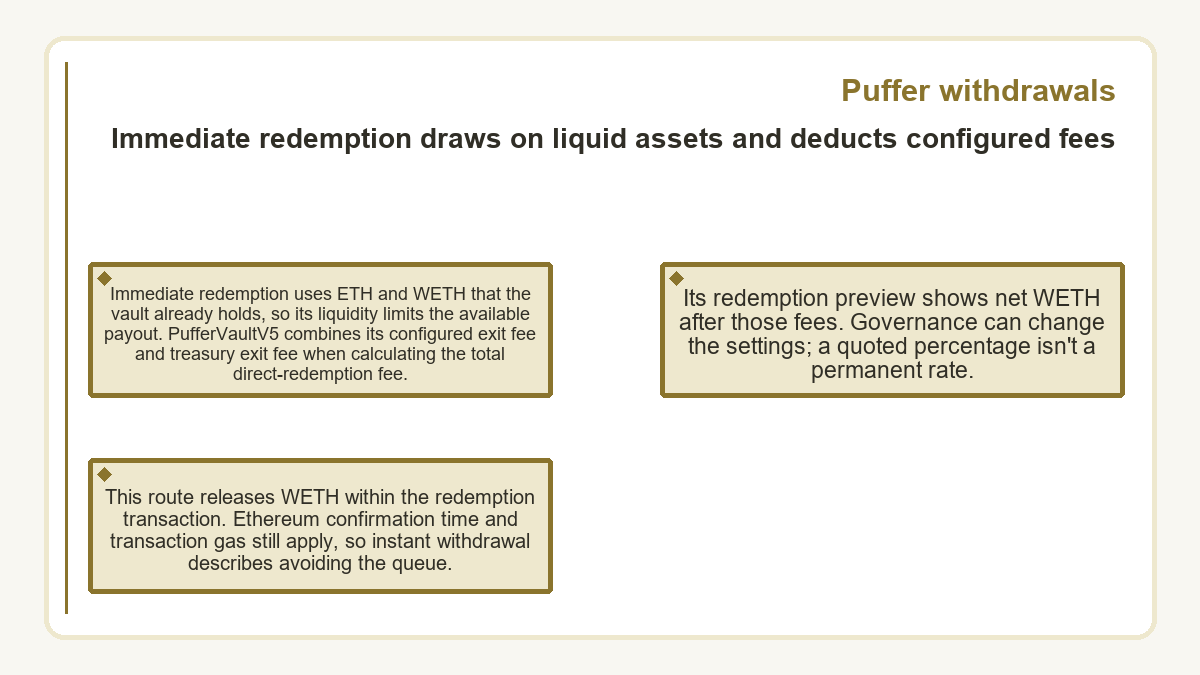
Immediate redemption draws on liquid assets and deducts configured fees
Immediate redemption uses ETH and WETH that the vault already holds, so its liquidity limits the available payout. PufferVaultV5 combines its configured exit fee and treasury exit fee when calculating the total direct-redemption fee. Its redemption preview shows net WETH after those fees. Governance can change the settings; a quoted percentage isn't a permanent rate. This route releases WETH within the redemption transaction. Ethereum confirmation time and transaction gas still apply, so instant withdrawal describes avoiding the queue.
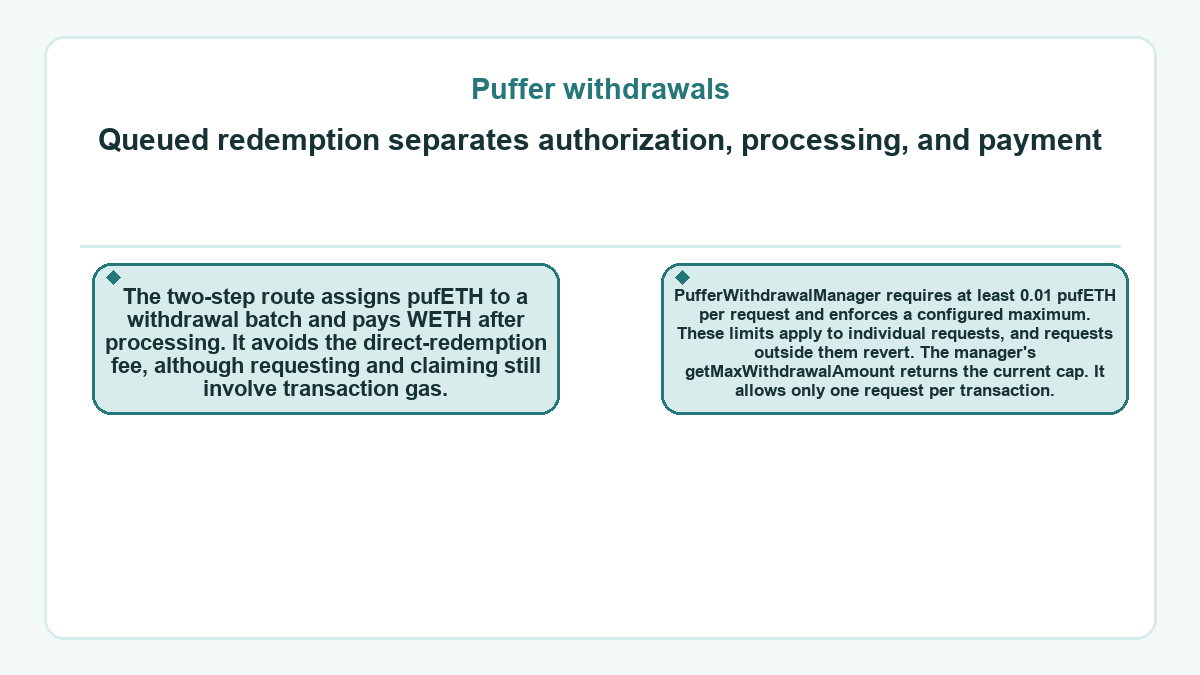
Queued redemption separates authorization, processing, and payment
The two-step route assigns pufETH to a withdrawal batch and pays WETH after processing. It avoids the direct-redemption fee, although requesting and claiming still involve transaction gas. PufferWithdrawalManager requires at least 0.01 pufETH per request and enforces a configured maximum. These limits apply to individual requests, and requests outside them revert. The manager's getMaxWithdrawalAmount returns the current cap. It allows only one request per transaction.
Request authorization and submission
The Permit grants spending permission
In the app's Permit flow, the signature authorizes spending the specified pufETH. It doesn't submit the withdrawal request. The Permit itself costs no gas; the subsequent transaction that submits the request does.
Submission moves pufETH into the queue
The request transaction transfers pufETH from the requesting wallet into the withdrawal manager, records the recipient and initial conversion rate, and places the request in a batch that needs processing before payment. Withdrawal Claims displays the pending request. The transferred pufETH leaves the wallet's spendable balance, while the recipient's WETH payout remains outstanding.
Batch processing determines readiness and payout
Available liquidity controls how much underlying capital must return before processing can finish. If the vault needs validator capital, the process includes voluntary validator exits and EigenLayer withdrawal processing. That can extend the wait to around 14 days. Enough existing liquidity can allow a faster withdrawal because the protocol doesn't need those exits. Batch scheduling adds another dependency: the withdrawal manager finalizes full batches. The estimate therefore doesn't assign every request the same release time.
PufferWithdrawalManager calculates a queued payout using the lower conversion rate from request creation or batch finalization. An increase while waiting doesn't raise that request's payout; a decline can reduce it. Once the batch finishes processing, the app presents ready requests in Withdrawal Claims for completion. The completion transaction wraps the released ETH as WETH and transfers it to the recorded recipient.
Validator exits separate principal, bonds, and operator rewards
A validator exit releases capital used for validation, with different accounting for the staking pool and its operator. Staker-funded principal returns to the pool. The operator's pufETH bond settles separately, and penalties can consume part or all of that bond before the remainder returns. Returning validator capital helps fund staker withdrawals; it doesn't make the validator's 32 ETH deposit an operator-owned balance. Validator ticket accounting also continues through the exit settlement, so unused tickets and the bond have separate release conditions.
Consensus rewards follow the Base claim route
Node operators claim eligible consensus rewards as pufETH on Base through a separate reward system. Its workflow uses weekly accounting and a security waiting period before claims open. Only rewards that actually left the validator on the Beacon Chain qualify for transfer to Base. Execution rewards go to the configured fee-recipient address through another channel. A consensus claim can therefore wait for accounting even when execution rewards have arrived. Claiming on Base requires ETH for transaction gas, and receiving pufETH there doesn't itself redeem that token for WETH on Ethereum.
Institutional exits follow vault permissions
Puffer Institutional assigns validator management to an institution-controlled Guardian account. Voluntary Exit Messages manage validator exits. Traditional staking withdrawals return capital to the institutional vault, while restaking withdrawals return it to EigenPods. The vault's permissions govern these operations. Its separate share-token system also has its own asset-withdrawal terms, so the retail pufETH fee settings and request limits don't establish institutional withdrawal terms.
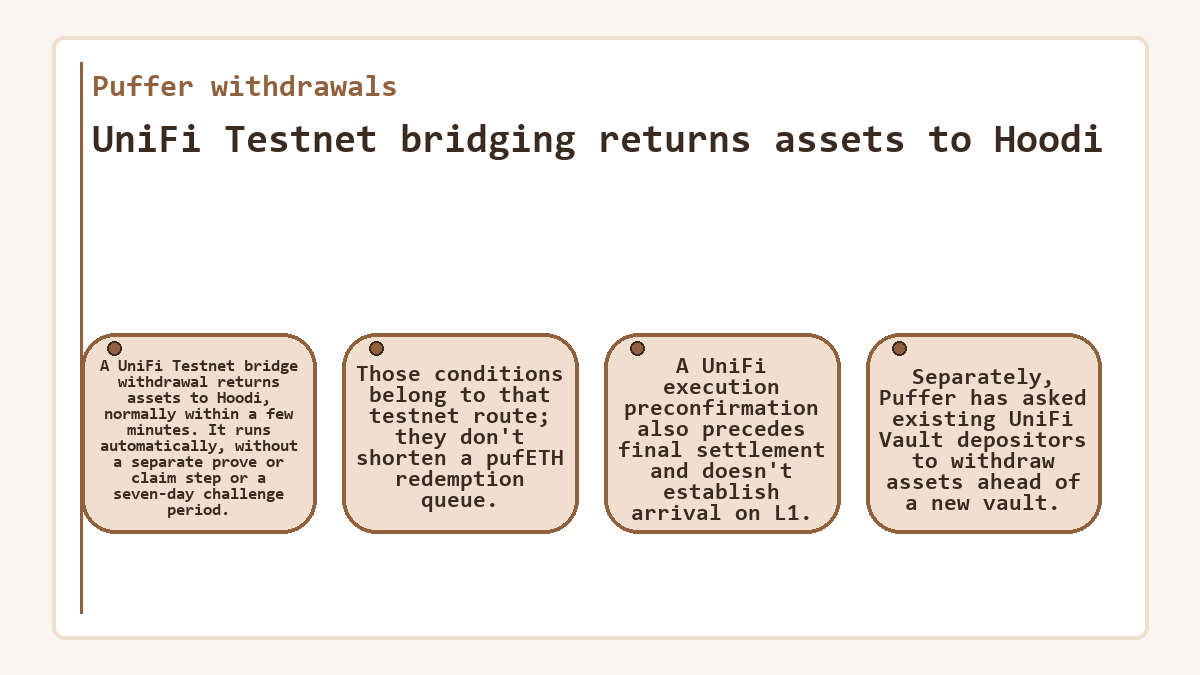
UniFi Testnet bridging returns assets to Hoodi
A UniFi Testnet bridge withdrawal returns assets to Hoodi, normally within a few minutes. It runs automatically, without a separate prove or claim step or a seven-day challenge period. Those conditions belong to that testnet route; they don't shorten a pufETH redemption queue. A UniFi execution preconfirmation also precedes final settlement and doesn't establish arrival on L1. Separately, Puffer has asked existing UniFi Vault depositors to withdraw assets ahead of a new vault.
Locked PUFFER becomes withdrawable when its lock expires
The non-transferable vlPUFFER represents voting power during the lock. This withdrawal returns PUFFER itself; it doesn't redeem staking shares for WETH.
Seven days after expiry, anyone can kick an unwithdrawn lock. The kicker receives 1% of the locked PUFFER, and the system automatically returns the remaining 99% to its owner. The fee arises when someone kicks the lock; merely passing the grace period doesn't automatically deduct it. Withdrawing before a kick keeps that fee from reducing the returned PUFFER.
Match the exit to the balance that you hold
Immediate and queued pufETH redemptions both pay WETH. Available liquidity limits the first route, while batch processing and its settlement rate constrain the second.
- For an immediate pufETH exit, compare the quoted net WETH with the vault's available WETH withdrawal limit.
- For a queued pufETH request, keep the amount within its minimum and configured maximum, and allow time for processing.
- For node-operator consensus rewards, use the Base claim route once the eligible distribution opens.
- For a UniFi Testnet balance, use the withdrawal direction back to Hoodi; that bridge handles completion automatically.
- For locked PUFFER, use the lock's expiry date and the seven-day grace period when assessing exposure to a kicker fee.
Still have questions?
Can I deposit into PufferVaultV5 and then redeem pufETH in one transaction?
PufferVaultV5 rejects a direct withdrawal or redemption after a vault deposit within the same transaction. Its deposit tracker enforces that restriction for the transaction's remaining calls. A separate transaction doesn't carry that earlier deposit marker, although liquidity, fees, and applicable permissions still govern whether the redemption can proceed.
Must a multisig node operator set a separate reward claimer on Base?
A node operator that registered through a smart-contract wallet must designate a rewards claimer address on Base. An Ethereum multisig address doesn't automatically establish control of the corresponding Base account. The reward-manager setup authorizes the selected Base address to claim operator rewards. Operators that registered through externally owned accounts don't need this extra setup.
Why is my UniFi Testnet bridge transaction missing from the Transactions tab?
The UniFi Testnet bridge's Transactions tab can display incomplete information without stopping the bridging process. A missing entry alone therefore doesn't establish a failed withdrawal. For the route back to Hoodi, the relevant completed result is the asset balance on Hoodi after processing.
When can a node operator withdraw unused validator tickets?
PufferProtocol permits deposited VT withdrawals only when the operator has no active or pending validators. Exit settlement deducts the VT burn before the remaining deposited balance becomes available. If calculated consumption is below the configured minimum VT amount, settlement burns that minimum or the operator's deposited VT balance if smaller. PufferProtocol's getMinimumVtAmount reports the minimum. Ending active validation alone doesn't prove that protocol accounting has finished. This withdrawal releases VTs, while the validator bond follows its separate settlement.
What asset does an institutional share-token withdrawal return?
Puffer Institutional supports native ETH withdrawals from its vault. Deposits can use ETH or WETH and receive institutional share tokens representing the deposit. The vault's asset-management rules and permissions govern those shares and the release of their backing. This is a separate withdrawal mechanism from retail pufETH redemption, so its terms don't automatically inherit the direct pufETH exit fees.
Updated