Puffer UniFi exposes preconfirmed state before its blocks seal
Puffer UniFi lets state reads at latest reflect a preconfirmed transaction before that transaction enters a sealed block. Its remote procedure call (RPC) interface exposes early receipts and updated state while block queries follow the sealed head. Event queries also wait for sealing. A receipt and subsequent state read must reach the same node for the receipt-to-state guarantee to apply. Until sealing, the early view can step back if UniFi discards the unsealed block.
Jump to a section
Follow the sealed and unsealed heads
UniFi keeps a sealed head alongside an unsealed block that the gateway builds from preconfirmation fragments, so different RPC methods can describe different stages of execution. The sealed head is the last block that completed consensus. The unsealed block sits one block ahead. If the sealed head has number
N
, the block under construction has number
N+1
.
Block queries stay on the sealed side.
eth_blockNumber
reports the sealed head, and
eth_getBlockByNumber
returns sealed blocks even with the
pending
tag. This preserves block-number polling without exposing unfinished blocks through block-shaped methods. Meanwhile, a state read at
latest
can already include changes from the next block. Pairing that read with the latest block header won't necessarily describe a single block.
Recognize the receipt's sealing state
A non-null transaction receipt can describe execution inside a preconfirmation fragment before UniFi seals the containing block, so receipt availability alone doesn't establish sealing. The receipt already gives the transaction a populated block number and transaction index. Those fields identify its position in the unsealed block.
A preconfirmed receipt carries a
blockHash
consisting of 32 zero bytes.
Alongside a non-null
blockNumber
, that zero hash identifies the preconfirmed stage. It isn't an RPC error. The zero value can't identify a sealed block for a block-hash lookup.
Once the block seals, the transaction's receipt reports the real block hash.
Receipts can appear within tens of milliseconds, with the block sealing up to about one second later. These timings describe early RPC responses and local block sealing. Neither an early receipt nor local sealing establishes final settlement on Ethereum. A UniFi receipt concerns rollup execution, while pufETH withdrawals follow the staking product's separate mode and liquidity rules.
Choose the state that a block tag selects
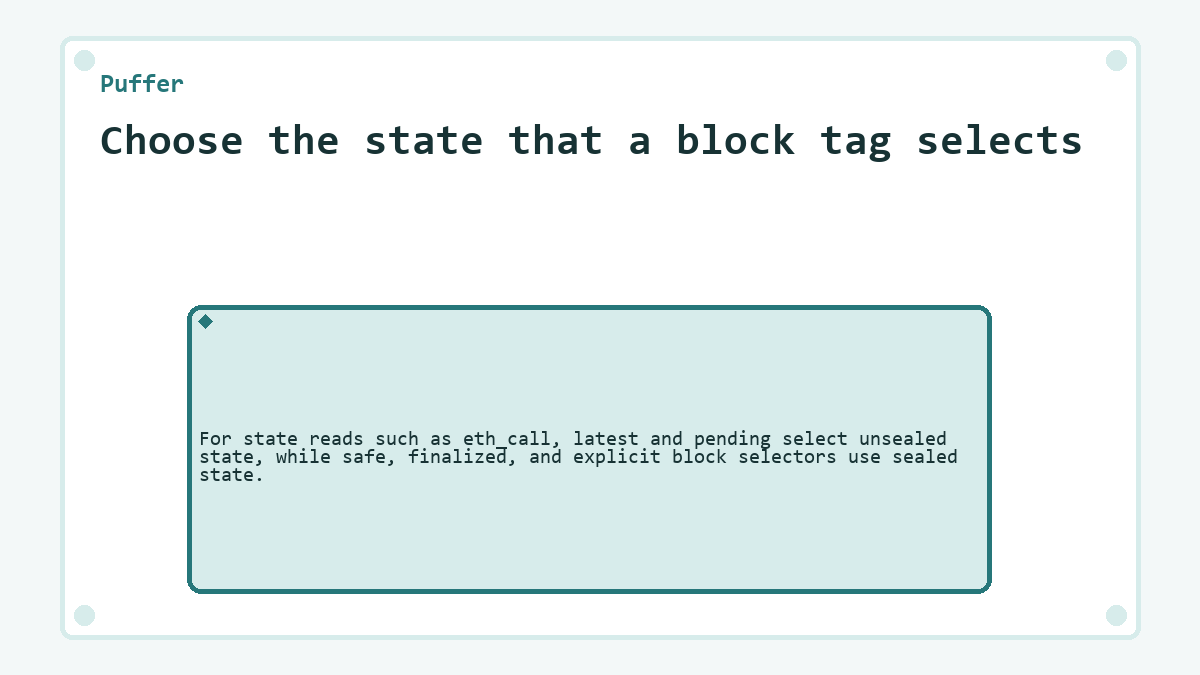
For state reads such as
eth_call
,
latest
and
pending
select unsealed state, while
safe
,
finalized
, and explicit block selectors use sealed state.
Read the early view
A contract call at
latest
can reflect a receipted transaction on the same node before its block seals. Many client libraries default contract reads to this tag. That default matters when an application expects the read and a block header to describe the same snapshot. The state response can include the next block's changes while the header still describes the sealed head. Selecting
pending
for these state reads also exposes the unsealed view.
Select a sealed view
Tags such as
safe
and
finalized
keep these state reads on sealed data. A specific block number or block hash also selects sealed state. These selectors suit reads that need a corresponding sealed block, rather than the newest preconfirmed changes. The tag's spelling still needs interpretation within the selected method: a block query doesn't acquire unsealed behavior merely because its tag says
pending
.
Receipt fields and RPC selectors
Receipt fields describe a preconfirmed transaction's position, while block selectors determine whether a supported method uses unsealed or sealed information. Their values carry different limits during the preconfirmation window.
| Field or selector | Documented value | Response meaning | Limit during preconfirmation |
|---|---|---|---|
Receipt
blockHash
|
32 zero bytes before sealing | Preconfirmed transaction | The zero hash can't identify a sealed block |
Receipt
blockNumber
|
N+1
, with
N
the sealed head
|
The unsealed block's number | A populated number doesn't establish sealing |
Receipt
transactionIndex
|
Populated, real transaction index | Transaction position in the unsealed block | The index doesn't establish sealing |
eth_call
block tag
|
latest
or
pending
|
Unsealed state | Discarding the unsealed block can revert this state |
eth_getBlockByNumber
block tag
|
latest
or
pending
|
Sealed head
N
|
Neither tag exposes the unfinished block |
eth_getBlockReceipts
block selector
|
pending
|
Receipts from the unsealed block |
latest
, a number, or a hash selects sealed receipts
|
A selector's meaning belongs to its method. Applying one rule to every RPC call would mix these views.
Keep receipt and state reads on one node
The receipt-to-state guarantee requires one node to serve the receipt and subsequent state read, so routing determines whether the requests share that guarantee. A non-null response from
eth_getTransactionReceipt
establishes the relevant prerequisite.
After a non-null receipt, an
eth_call
at
latest
on the same node reflects that transaction.
The guarantee also covers
eth_getBalance
,
eth_getStorageAt
,
eth_getCode
, and
eth_getTransactionCount
at
latest
or
pending
.
A single RPC address can front multiple nodes. Behind a load balancer, one node may return the receipt while another serves an older state view. An endpoint that targets one node, or preserves session affinity, provides the node continuity that early read-your-writes needs. Sharing an RPC address alone doesn't supply that continuity.
Without node continuity, application logic needs to allow the state read to lag the receipt. Behavior that requires a sealed record should depend on sealed data. Early read-your-writes still needs the same-node prerequisite; switching tags doesn't establish that another node has the same early state.
Why can a UniFi event query stay empty after a receipt arrives?
A UniFi event query can stay empty during preconfirmation because
eth_getLogs
, filters, and log subscriptions expose events only from sealed blocks. A receipt can already contain events from execution that these feeds haven't reached.
Events in the receipt
The receipt's
logs
field exposes any events that the transaction emitted during its preconfirmed execution. Event-driven applications can use those entries for early feedback. The entries already contain the correct block number and transaction index, together with the zero block hash that marks preconfirmation. Receipt logs remain volatile before sealing and don't yet appear in sealed log-query results.
Filters and subscriptions
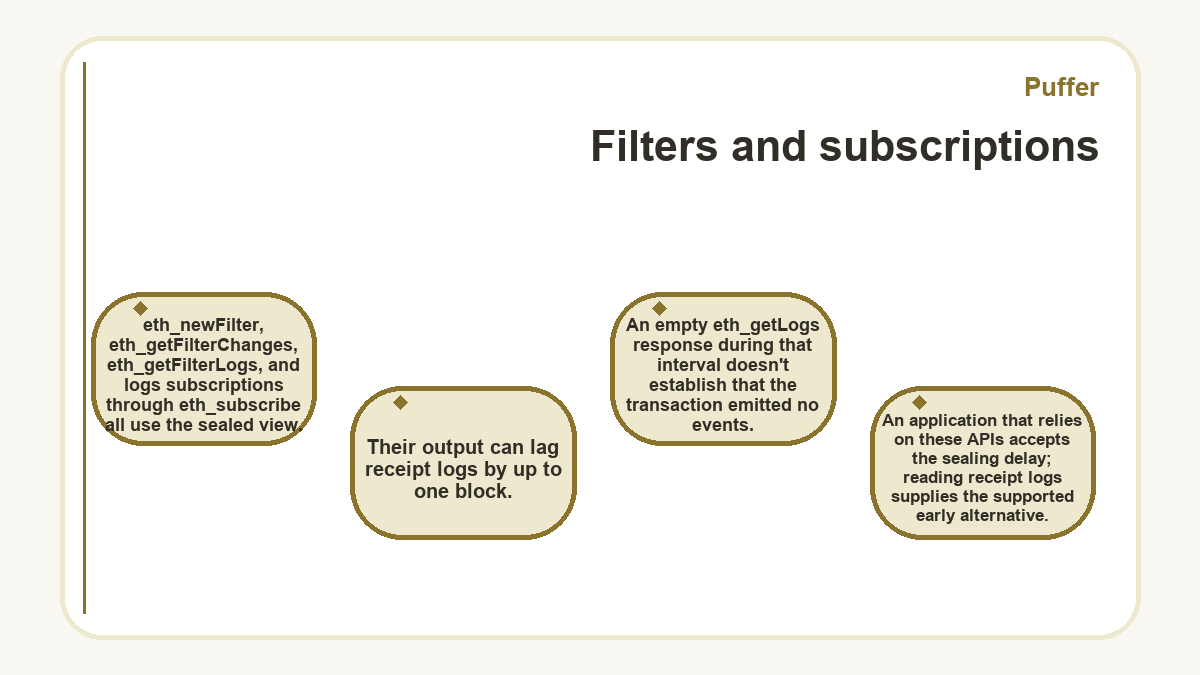
eth_newFilter
,
eth_getFilterChanges
,
eth_getFilterLogs
, and
logs
subscriptions through
eth_subscribe
all use the sealed view. Their output can lag receipt logs by up to one block. An empty
eth_getLogs
response during that interval doesn't establish that the transaction emitted no events. An application that relies on these APIs accepts the sealing delay; reading receipt logs supplies the supported early alternative.
Account for a discarded unsealed block
If UniFi discards an unsealed block,
latest
state steps back to the sealed view until another fragment supplies a new early state. A preconfirmed receipt has the same pre-seal volatility.
This affects balances and contract values that an application uses to trigger another action. Their early responses can include changes that disappear from the unsealed view. Logic that needs a sealed record must wait for the corresponding sealed data. Keep this condition separate from the routing issue: a different node can expose older state, and a discarded unsealed block can cause the same node's state to step back.
Request proofs from sealed state
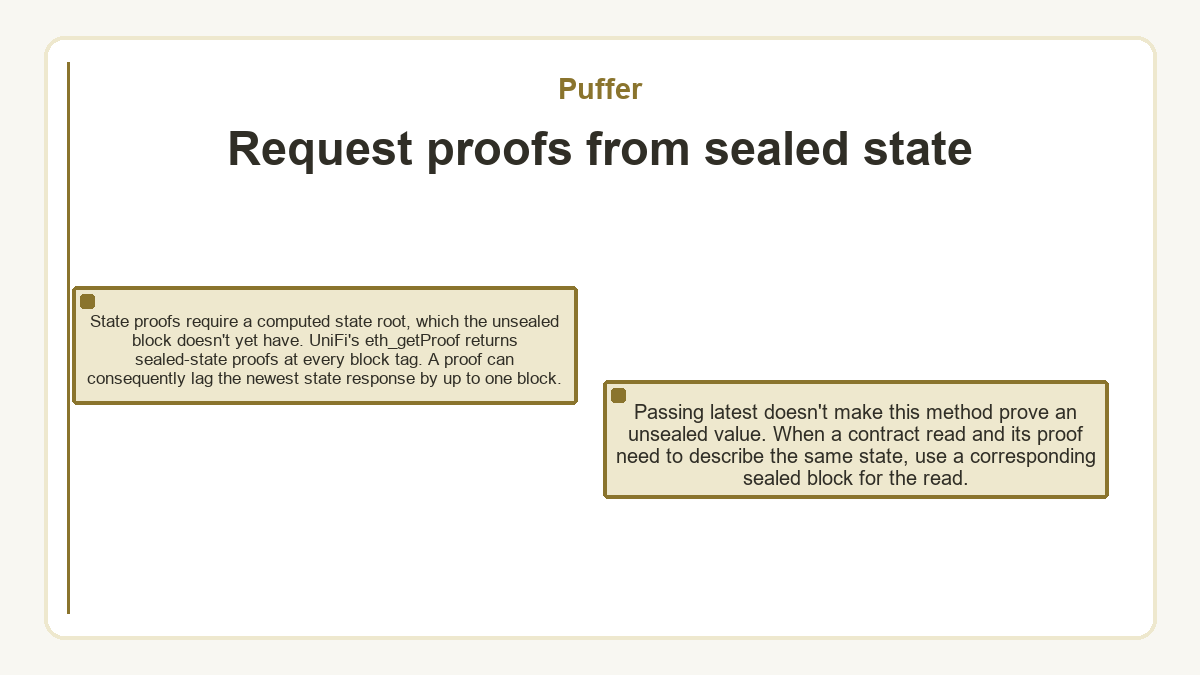
State proofs require a computed state root, which the unsealed block doesn't yet have.
UniFi's
eth_getProof
returns sealed-state proofs at every block tag.
A proof can consequently lag the newest state response by up to one block. Passing
latest
doesn't make this method prove an unsealed value. When a contract read and its proof need to describe the same state, use a corresponding sealed block for the read.
Apply early state to access lists and simulations
Access-list creation and transaction simulation can use unsealed state when their supported block tags select that view, extending early execution visibility beyond ordinary contract reads.
eth_createAccessList
uses unsealed state at
latest
and
pending
. Its
safe
,
finalized
, numeric, and hash selectors use sealed state.
eth_simulateV1
uses an unsealed base at
latest
or
pending
, and a sealed base with the other supported selectors. Its early base retains the unsealed view's volatility. Requests that supply a block hash select sealed data throughout the RPC interface, including
eth_simulateV1
.
Everyday questions about Puffer
Does UniFi use different JSON-RPC method names or signatures?
UniFi keeps the existing JSON-RPC method names and signatures. Familiar call syntax therefore doesn't identify the state view behind a response. Compatibility also depends on interpreting the method's behavior: a library's default latest contract read can include preconfirmed state, even while its block queries describe sealed blocks.
Can I fetch a preconfirmed transaction's raw data by its transaction hash?
UniFi's eth_getRawTransactionByHash supports preconfirmed transactions. The structured eth_getTransactionByHash response is also preconfirmation-aware. These hash-based lookups can expose a transaction before its block seals. Retrieving the transaction establishes early availability; it doesn't establish a sealed block or final settlement on Ethereum.
Which blocks can eth_feeHistory cover during preconfirmation?
UniFi's eth_feeHistory covers sealed blocks, up to the sealed head. Its available history doesn't extend into the block currently under construction.
How does pending affect eth_getTransactionCount on UniFi?
For eth_getTransactionCount, pending uses the maximum of the transaction pool's nonce for the queried account and that account's nonce in unsealed state. Its latest view uses unsealed state, while safe, finalized, numeric, and hash selectors use sealed state.
Will eth_estimateGas include preconfirmed state?
UniFi's eth_estimateGas uses unsealed state when its block tag is latest or pending. The safe and finalized tags, and explicit block numbers or hashes, use sealed state. The selected tag therefore determines the state behind the estimate, and an estimate against unsealed state retains that view's pre-seal volatility.
What does eth_getBlockTransactionCountByNumber count during preconfirmation?
UniFi's eth_getBlockTransactionCountByNumber reads transaction counts from sealed blocks. It doesn't include the unfinished block's transactions merely because early receipts already exist. This differs from the account-level eth_getTransactionCount, which supports unsealed state. The account-level method returns the account's nonce.
Updated